
Exclusive Project at Airbnb
Project Overview
Why we did it?
To boost profitability during challenging market conditions (2020-2021), Airbnb China launched the "Exclusive Program," inviting top hosts to list solely on Airbnb for unique benefits. The immediate goal was restoring host revenue and increasing platform bookings, while the long-term aim was building a competitive advantage through exclusive, high-quality inventory.
What made it hard?
- Intense Local Competition: Dominant rivals (Tujia, Ctrip) normalized cross-listing, creating high resistance to exclusivity.
- Host Risk Aversion: Key hosts feared income loss from relying on a single platform and found the initial value proposition unclear.
- Building Operations from Scratch: Required complex alignment across Engineering, Data Science, Product, and Legal to establish scalable workflows.
- High-Stakes Pressure: With aggressive adoption targets and a zero-churn mandate, we had to prove immediate value to win over skeptical hosts from Day 1.
My Role & Approach
Faced with aggressive targets and limited design resources, I stepped in to design the missing pieces myself. I managed a team of 4 account managers while acting as the functional designer for the program.
- Research & Iteration: Embedded direct user feedback including surveys and interviews into our daily workflow to validate our strategy.
- MVP Design: Designed the Revenue Report and Content Strategy myself to fill critical product gaps.
- Service Design: Created the operational blueprint and standard operating procedures.
Project details
Phase 1: The Iterative Discovery
Our cross-functional team adopted a Lean Startup approach, launching a minimum viable product to validate demand first.
The Hypothesis and MVP Setup
Product: We launched the Core Signing Feature to complete the enrollment.
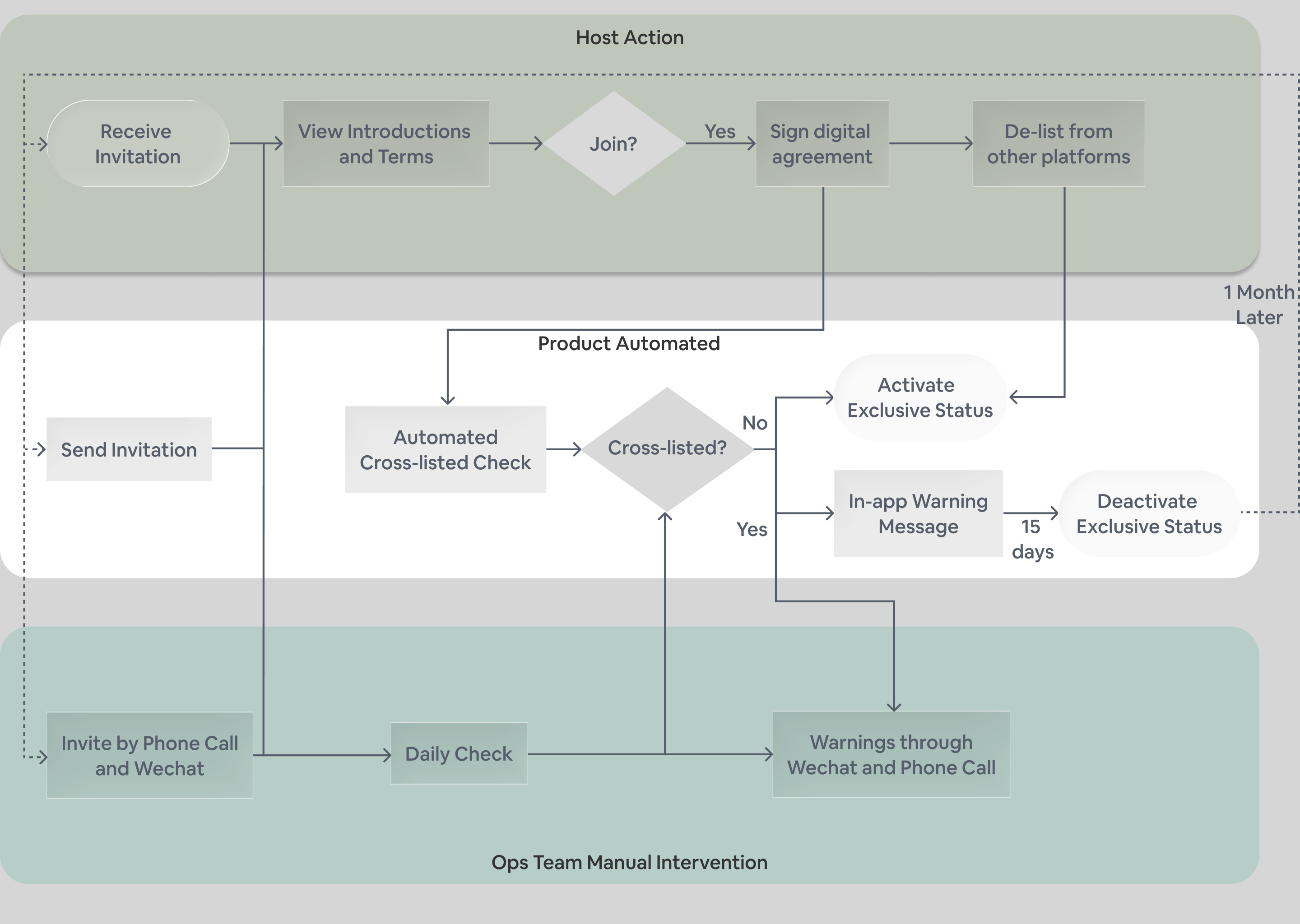
Operations: I designed a Service Blueprint based on our team's past experience, establishing the standard SOP for Account Managers.
The pilot
The Pilot & Friction: We ran a 2-week pilot with the MVP workflow. While the process worked technically, the conversion results fell short of the 30% target.
What's the gap?
Navigating Resource Constraints: With the external Research Team fully booked for the quarter, we faced a critical bottleneck. To avoid delays, I decided to bypass formal research channels and leverage my operational advantage. Utilizing my direct access to front-line interactions, I integrated data collection into our daily workflow, treating every host touchpoint as a qualitative interview opportunity.
This analysis revealed that our MVP failed to address two deep-seated psychological barriers:
The Methodology: I conducted a Thematic Analysis on 200+ interaction logs between hosts and Account Managers.
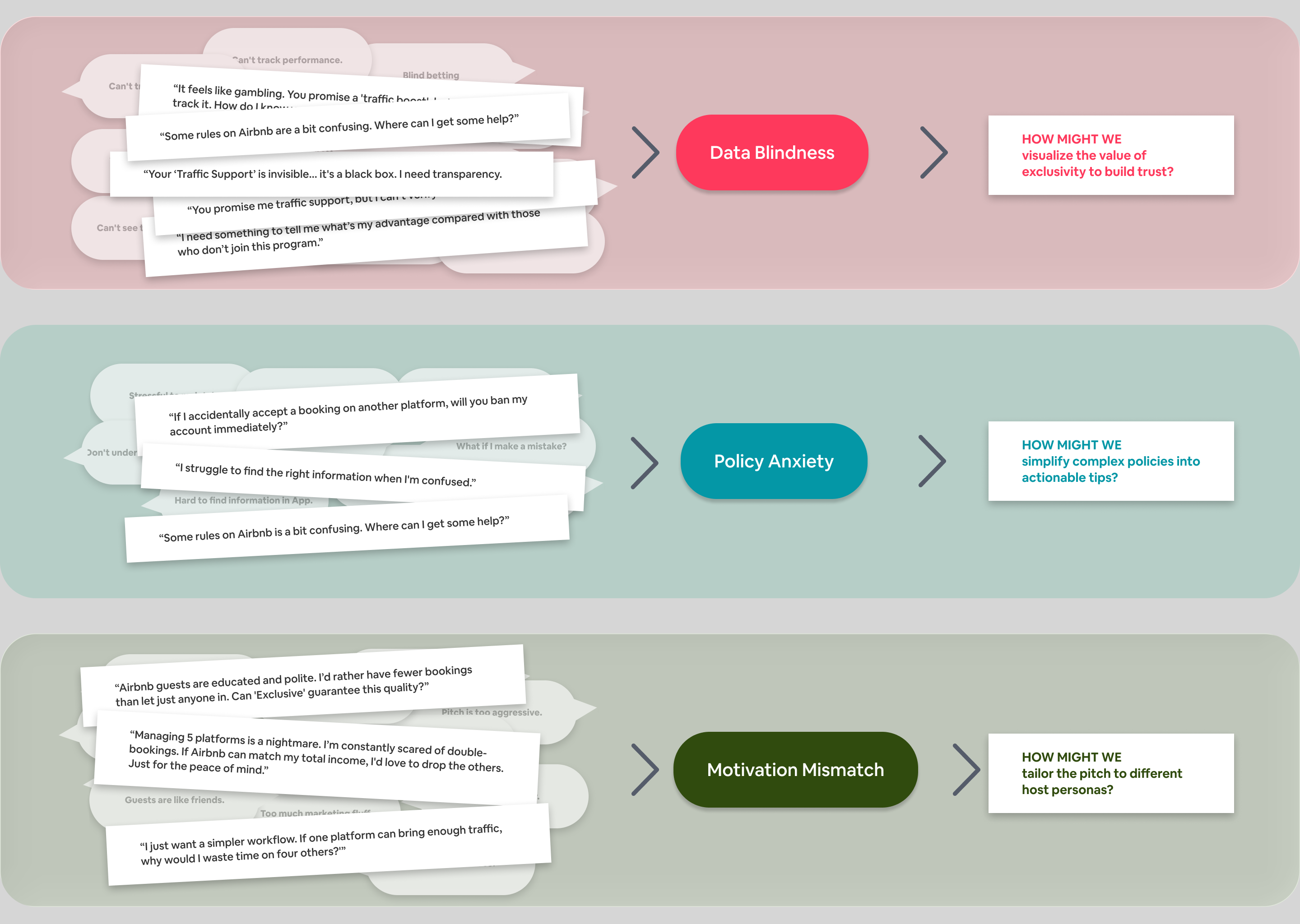
Insight A: Data Blindness
Hosts couldn't see rankings or traffic data, viewing exclusivity as an "uncalculated risk." We needed to shift from abstract promises to Visualizing Value. The goal was to provide data transparency, allowing hosts to "see" the ROI and calculate the risk themselves.
Insight B: Policy Anxiety
The complex rules were overwhelming for hosts. We needed a way to break down these policies into bite-sized tips in order to reduce users' cognitive load.
Insight C: Motivation Mismatch
Our generic "one-size-fits-all" pitch ignored the diversity in our host community. Two distinct personas were found during research:
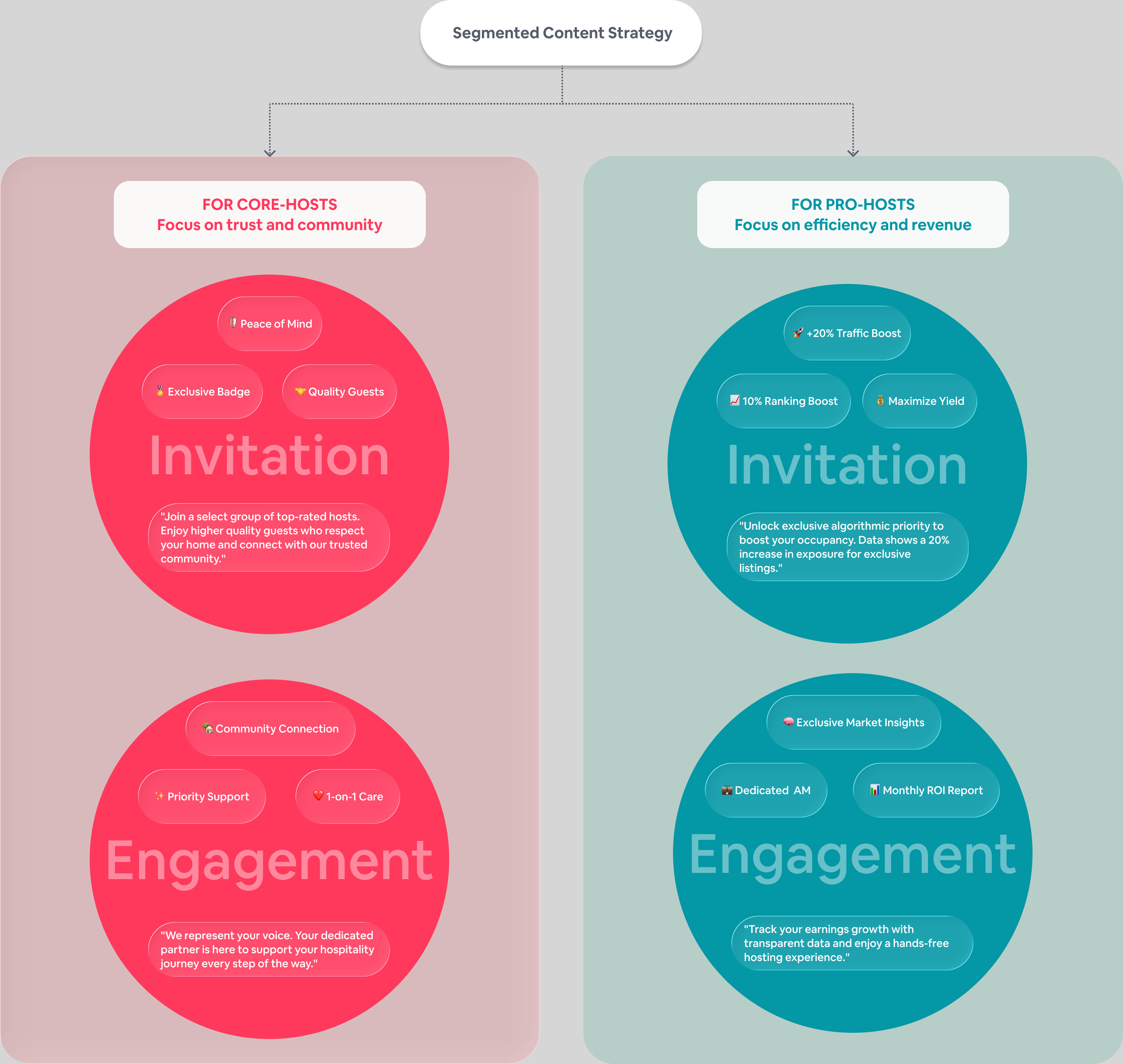
- Business Hosts: They are profit-driven and focused on ROI and efficiency.
- Core-Value Hosts: They are motivated by brand connection and hospitality. They felt alienated by aggressive commercial jargon.
I decided to personalize relevance. We moved to a segmented communication strategy, tailoring our value proposition to match the specific "language" of each persona.
Phase 2: Design Solutions
Guided by the research insights, I developed a multi-disciplinary design strategy to remove friction at every touchpoint. I focused on three key design pillars: Visualizing Value, Simplifying Complexity, and Personalizing Relevance.
Visualizing Value: The Monthly Performance Report
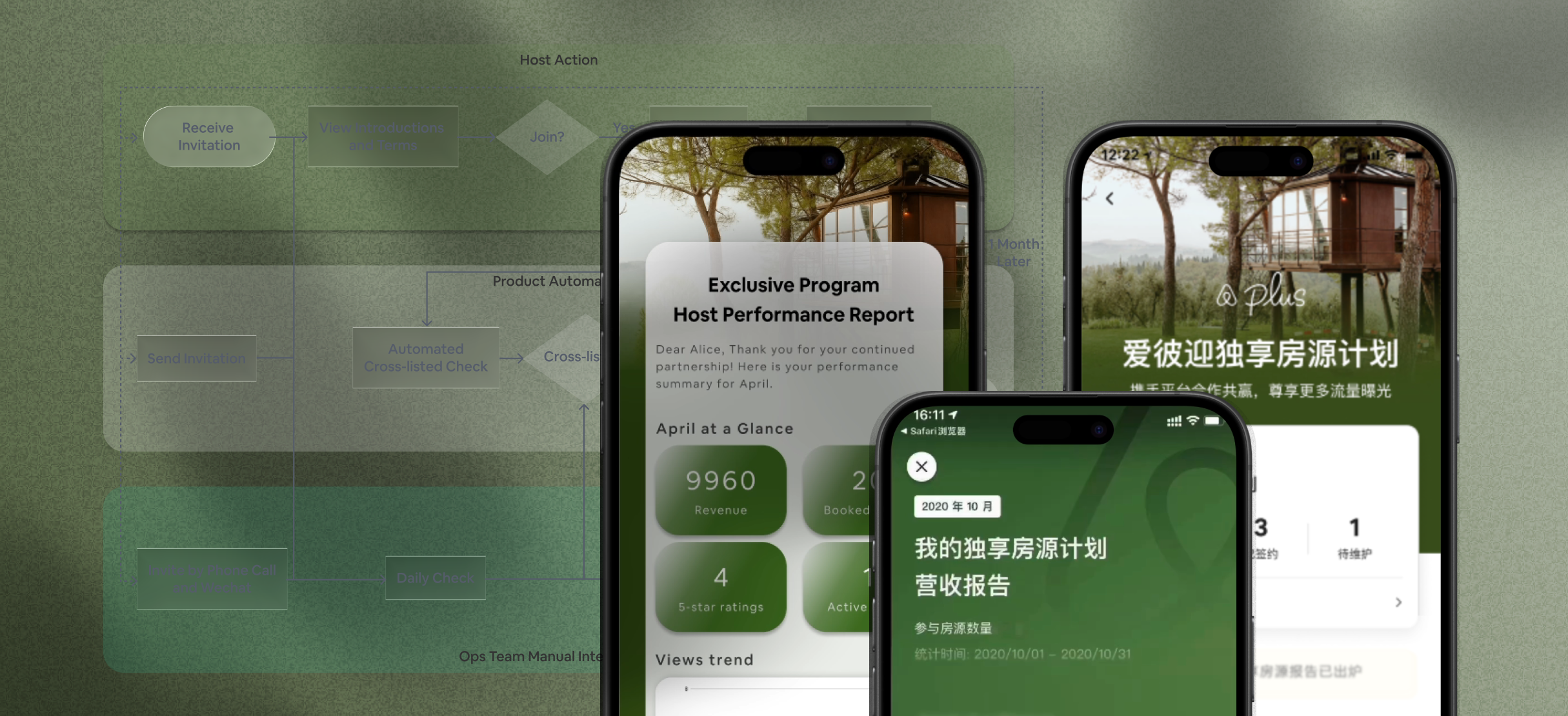
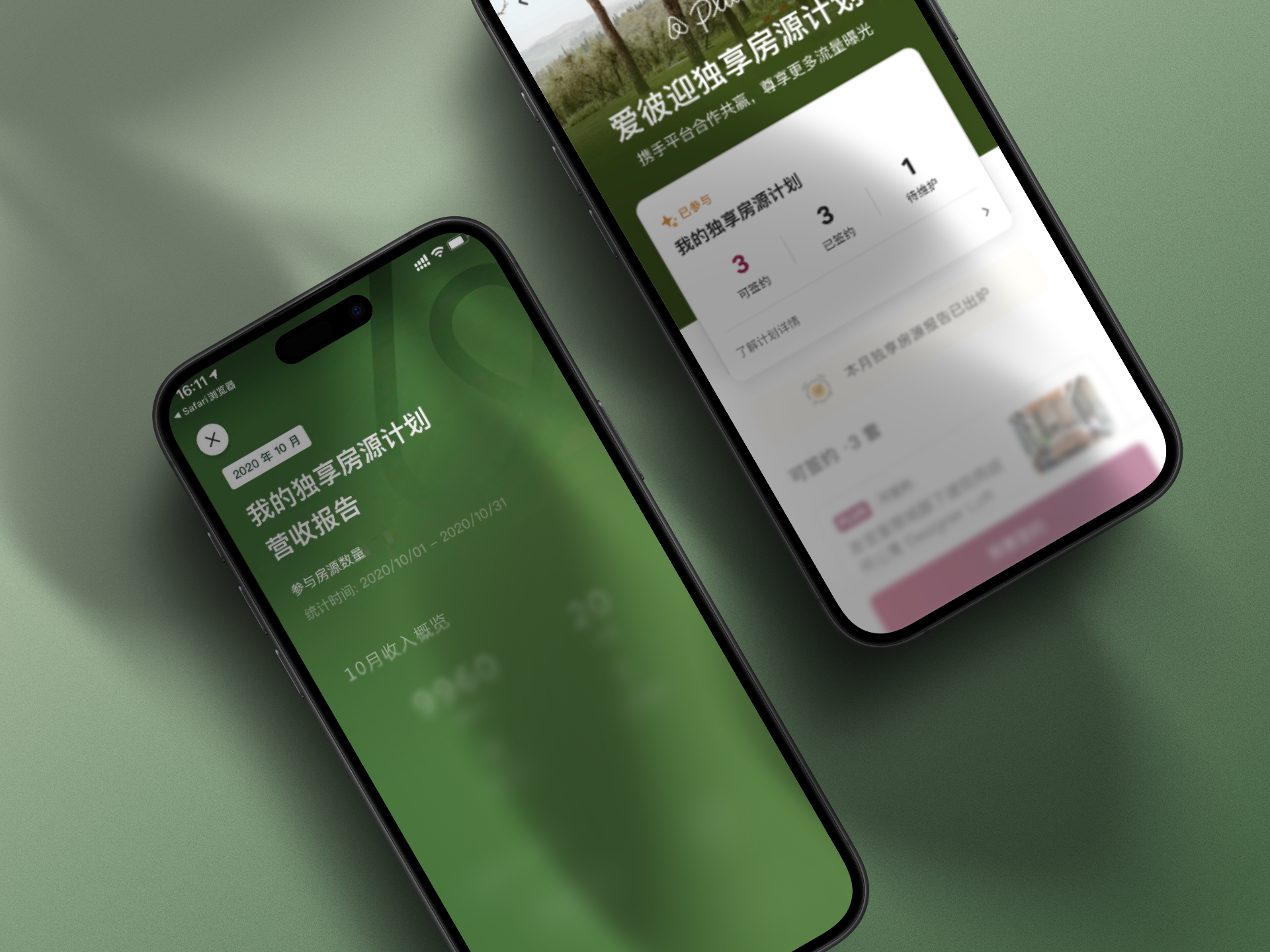
To bridge the trust gap, I designed a mobile-first performance dashboard sent directly to hosts, turning invisible data into visible proof. I aimed to provide contextual transparency by visualizing trends and >qualitative feedback. Host could not only visualise profits uplift through the programme, but also improve by personalised tips.
Transforming invisible data into visible proof. Key metrics are highlighted at the top to provide an instant health check.
Line charts replace static numbers to show growth over time, helping hosts understand seasonality and demand patterns.
Moving beyond data to action. The 'Insight' card translates negative feedback into concrete solutions like earplugs.
Reducing Anxiety: The Serialized Knowledge Hub
To tackle the complexity of scattered platform policies, I initiated a content collaboration with my operations team. I held weekly brainstorming sessions to synthesize hot topics from daily user inquiries, ensuring our content addressed real-world pain points rather than just legal requirements.
I designed a serialized "Exclusive Hosts Only Tips". We transformed dry, complex rules into bite-sized, visually engaging cards released on a weekly basis, in order to reduce hosts' anxiety, build emotional connection and educate hosts on operational best practices to directly boost their revenue.
Optimizing Conversion: Content strategy
I optimised Invitation Playbook, shifting from generic content to a persona-based communication strategy. I designed two distinct sets of scripts and talking points tailored to the unique drivers of our two core host segments.
Phase 3: Impact and Results
Our "Design + Ops" strategy didn't just meet the immediate targets, it also reshaped how the platform communicates value to hosts.
UX Impact: Proving Value via MVP
The most significant win was proving the business case for data transparency. The manual "Monthly Performance Report" served as a high-fidelity MVP, validating strong host demand for performance visibility.
The manual reports achieved positive feedback, proving that "Data Blindness" was indeed the primary blocker. Based on this validated success, the Product & Engineering teams prioritized and built the Performance Report into the official Airbnb App and was available to all program hosts.
Business Results: Exceeding Targets
By redesigning the information architecture and tone, I removed the psychological barriers of "risk" and "complexity" for hosts.
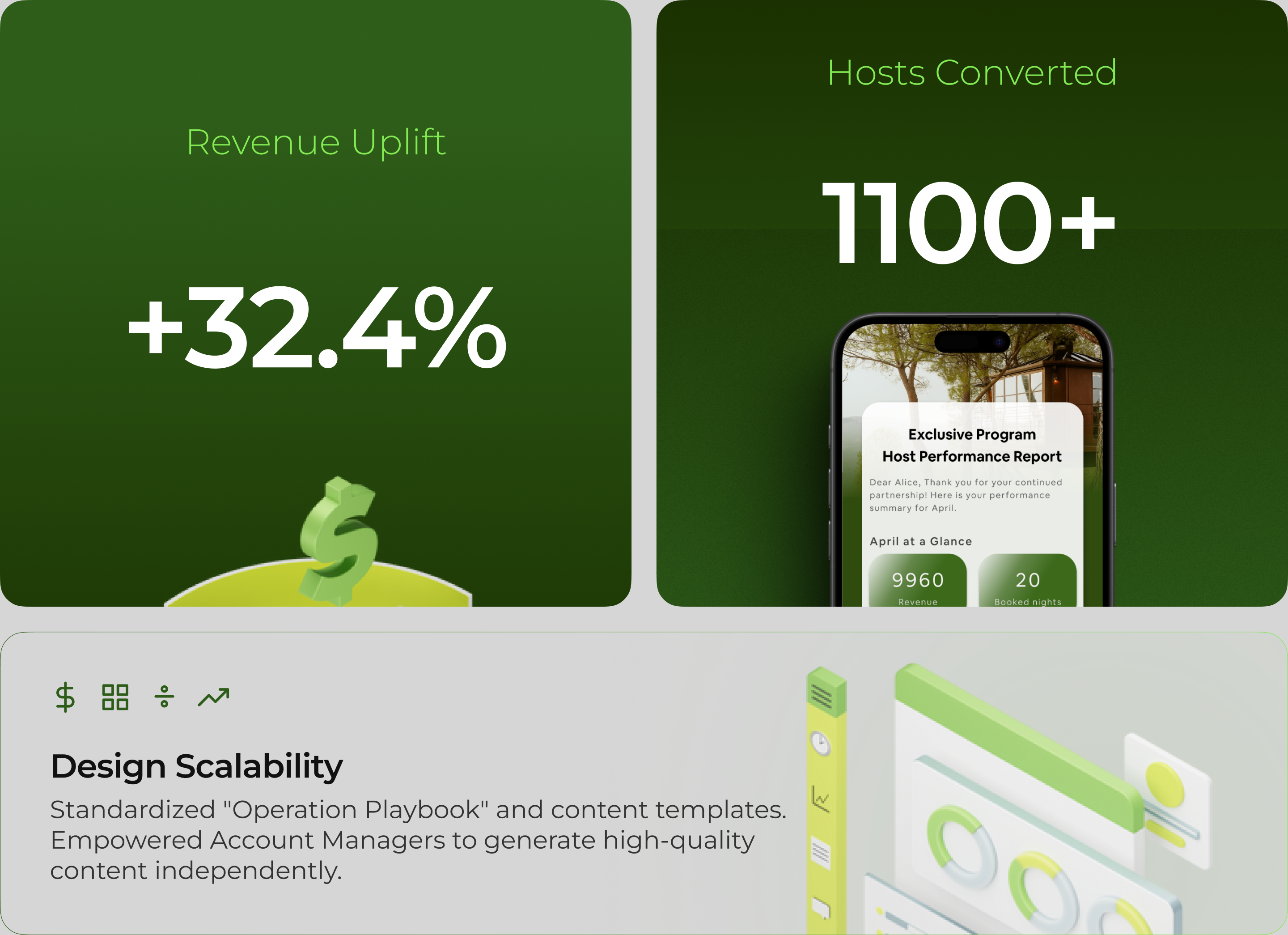
Significant Revenue Uplift (Primary Win): Achieved a +32.4% total revenue increase for the participating cohort compared to the control group.
Adoption at Scale: Surpassed the aggressive 30% sign-up target within the initial launch phase, successfully converting 1,100+ high-value hosts to the exclusive model.
Design Scalability: Standardizing the System
Created the "Exclusive Hosts Only Tips" templates and "Communication Playbook," ensuring visual and content consistency across all touchpoints. Enabled Account Managers to generate high-quality content independently, freeing up design resources and speeding up service delivery.